Certified Passport Translation in Canada
Translate your foreign passport or national ID by an accredited Canadian translator. Required when your travel document uses a non-Latin alphabet or when a Canadian authority needs to verify your identity from a foreign-issued ID. IRCC-accepted, delivered in 48 hours.
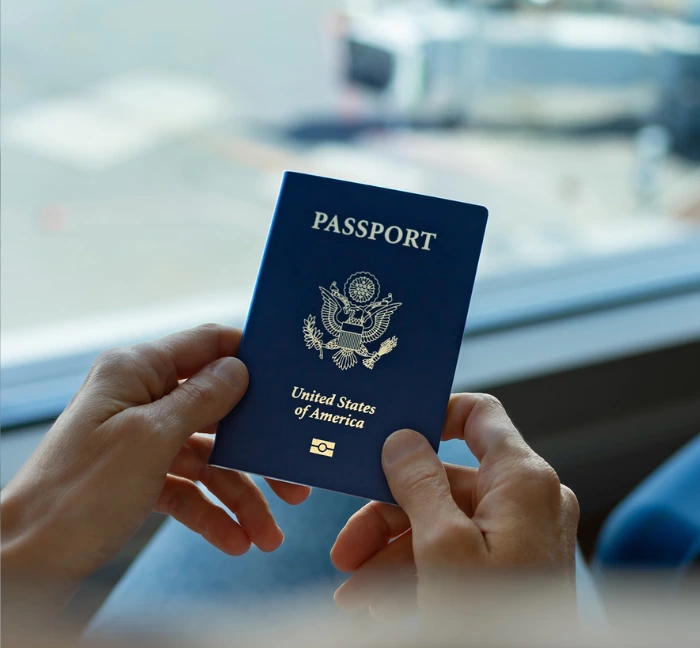
Does your passport really need a certified translation?
A modern passport is internationally readable to a point — the biographical data page is partially designed to be understood by border officers worldwide, with names, dates, and a machine-readable zone at the bottom. But this universal layer breaks down quickly once you move beyond border control. A Canadian bank opening an account, a provincial notary verifying identity for a real estate transaction, a Canadian university registrar admitting a foreign student, an IRCC officer reviewing an application — all of them need to read every word on the document, not just the highlighted fields. And if your passport carries observations, endorsements, visas, or extension stamps in a non-Latin script, that information becomes invisible to the Canadian reader.
The same applies to national identity cards. In many countries, the national ID is the primary identification document — far more commonly used than a passport in daily life. Argentinian, Brazilian, Mexican, Indian, Chinese, and most European nationals carry an ID that contains more information than just a name and photo: address, parental designations, marital status, blood type, religion, sometimes even tax identification. A certified translation makes this content accessible to Canadian institutions that would otherwise treat the card as opaque, regardless of how clearly the photo and bearer's name appear.
Common situations requiring a translated passport or ID
Identity translation requests follow predictable patterns. These are the most frequent contexts in which a Canadian institution will ask for a certified translation of your travel or identification document:
IRCC immigration applications
Required when your passport bio page, observations, or visa stamps contain text in a non-Latin script that an officer cannot read directly.
Banking and notarial procedures
Canadian banks and notaries require a translated identity document to open accounts, verify signatures, or process real estate transactions.
University and college admissions
Universities admitting international students need a verified identity match between application files, transcripts, and the passport biographical page.
Visa and work permit extensions
Used to verify identity continuity when applying for visa extensions, work permit renewals, or status changes from inside Canada.
Insurance and pension claims
Required by insurers and pension administrators to verify the identity of claimants whose primary ID was issued abroad.
Family reunification and sponsorship
IRCC requires translations of all identity documents for sponsored family members, including spouses, children, and dependent parents.
Types of identity documents we translate
Beyond passports, we handle the full spectrum of identity documents issued worldwide. Some carry more information than a Canadian reader would expect — parental names, religion, tribe, place of registration — all of which need to be faithfully translated:
- ✓Passports — biographical pages, observation pages, visa stamps, entry/exit endorsements, extension stickers
- ✓National ID cards — Indian Aadhaar, Brazilian RG, Argentinian DNI, Spanish DNI, Mexican INE, Chinese resident ID, European national ID cards
- ✓Residence and consular documents — foreign residence permits, consular registration cards, diaspora ID cards, OCI cards
- ✓Specialized identity documents — refugee travel documents, stateless person identity certificates, laissez-passer, diplomatic passports

What appears on your translated passport
A passport translation must do more than render the obvious fields. The certified deliverable includes:
Pricing & delivery time
Most procedures only require the biographical page. Full-passport translation (every visa stamp and observation page) is available when you need it — typically for asylum claims and complex immigration files.
Photographing your passport for translation
Capture the biographical page
Open the passport flat. Photograph the data page in good light, no glare on the laminate. A high-resolution smartphone photo is enough.
Indicate the recipient
IRCC, university, bank, notary — tell us where the translation is going so we apply the right level of formatting and detail.
Receive your certified PDF
Delivered within 48h. Easy to upload to portals or print for in-person verification at banks and notarial offices.
Passport translation — FAQ
My passport has the bio page in English already. Do I still need a translation?
Many passports issued by non-English-speaking countries do include an English version of the biographical data — Chinese, Russian, Arabic, Vietnamese, Korean passports often dual-print key fields. However, IRCC and other Canadian institutions look at the entire document, not just the bio page. If your passport contains observations, name annotations, parental information, or visa stamps in a non-Latin script, a certified translation may still be required. When in doubt, check with the recipient first — we will not push for unnecessary work.
Why does IRCC sometimes ask for a translation of an English-printed passport?
The most common reason is name spelling variation. If the name on your passport is transliterated from Arabic, Cyrillic, Chinese, or another non-Latin script, the spelling on your bio page may differ from how the same name appears on other documents (birth certificate, marriage certificate, school records). A certified translation reconciles these variations explicitly, confirming for the IRCC officer that they refer to the same person.
Should I translate only the biographical page or the entire passport?
For most procedures, the biographical page is sufficient. We translate the entire passport — including every visa, entry stamp, and observation page — when the recipient explicitly requests it, or when you are submitting a complex file (refugee claim, sponsorship of multiple family members, judicial proceedings) where your travel history matters. The price difference is significant, so we recommend confirming the scope with the recipient before ordering.
Can you translate my national ID card instead of my passport?
Yes, when the situation calls for it. National ID cards from countries like Mexico (INE), Argentina (DNI), India (Aadhaar), Spain (DNI), Brazil (RG), China (Resident ID), and most European nations are routinely translated for Canadian use. Be aware though: for IRCC immigration purposes, a passport is almost always the required document. National ID translations are more commonly used for banking, university applications, notarial procedures, and provincial administrative procedures.
My passport has been expired for two years. Can it still be translated?
Yes, expired passports can be translated and the translation remains technically valid. However, most Canadian authorities will not accept an expired passport as proof of current identity. The translation is still useful when you need to prove past identity for a specific procedure — for example, demonstrating that a previous immigration record was made under the same identity as your current one, or supporting an estate file referencing the deceased's former identity.
How is the transliteration of my name handled?
We follow internationally recognized standards (ISO 9 for Cyrillic, ALA-LC for Arabic, Pinyin for Chinese, Hepburn for Japanese), and we match your name's spelling to how it appears on other documents you've previously submitted in Canada — your driver's licence, immigration documents, or banking records — to avoid creating new identity discrepancies. If you have a preferred transliteration, just tell us when uploading.
Other identity-related documents we translate
Verify your identity in Canada with confidence
Accredited translators · Name transliteration matched · IRCC-accepted · 48h delivery
Order online →